Last updated: 28 September 2026
Slay the Spire 2 Beginner's Guide First Win Tips
Slay the Spire 2 is Mega Crit's follow-up to the game that defined the roguelike deckbuilder genre. It entered Steam Early Access on 5 March 2026, bringing five playable characters, well over 500 cards, close to 300 relics, 63 potions, and online co-op for up to four players (Mega Crit hasn't published exact card/relic totals, and both keep growing with Early Access content patches — treat these as ballpark figures, not a fixed spec). If you've never played STS1, or if you bounced off it, this guide covers everything you need to understand the game's logic and finish your first full run.
01The Core Loop
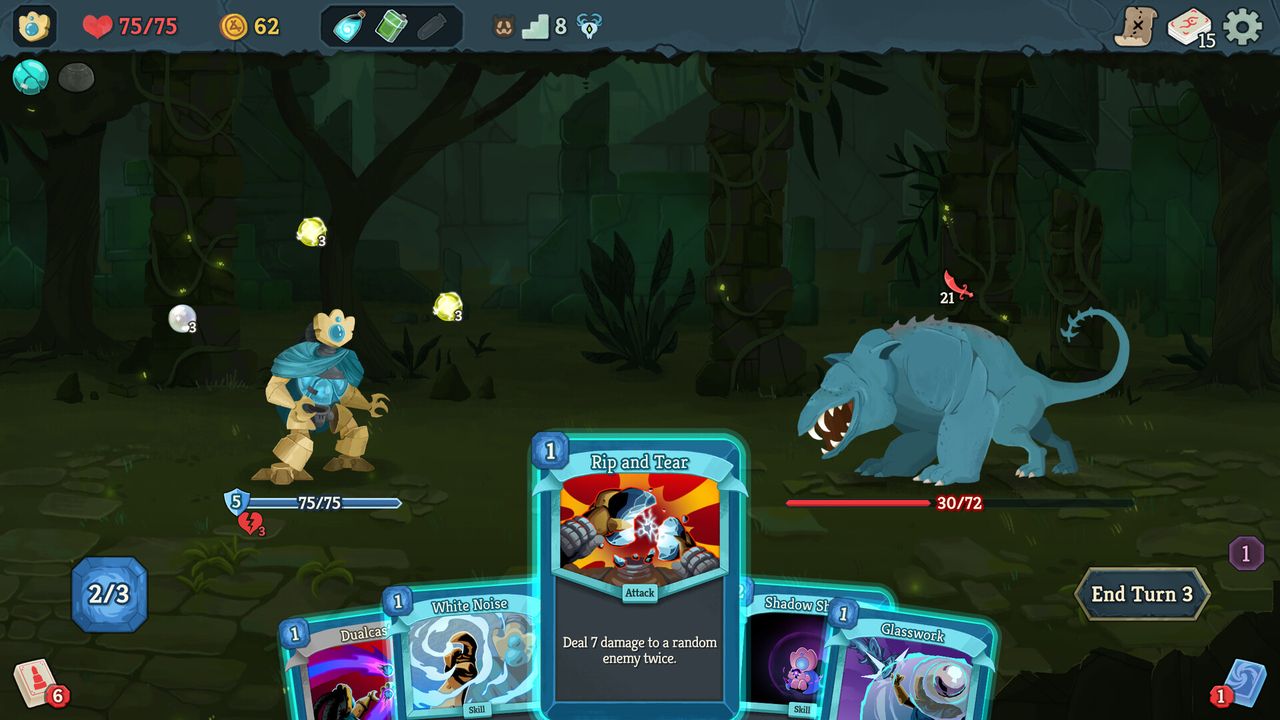
Every run of Slay the Spire 2 follows the same structure. You start at the bottom of a procedurally generated map and fight your way upward through three Acts, each ending in a boss encounter. Along the way you fight regular enemies, optional Elite enemies (harder but always worth fighting for the rewards), and rest at campfires.
Each combat works like this: you draw five cards, spend your Energy to play them (you start each run with 3 Energy per turn), then end your turn so the enemy acts. Enemies telegraph their next action — an icon above them shows whether they are going to attack, defend, or apply a debuff on their next turn. Reading those intents before you play your cards is one of the most important habits to build early.
- Attacks deal damage, sometimes apply debuffs like Vulnerable (take 50% more damage) or Weak (deal 25% less damage).
- Skills provide Block (temporary hit points that absorb the next hit), draw extra cards, or apply buffs.
- Powers are permanent effects that last the rest of combat — they cost Energy to play but provide compounding value for every turn they're active.
When you defeat enemies, you're offered a choice of three cards to add to your deck. You do not have to take one — skipping is a valid choice if none of the options fit your current strategy.
02The Five Characters
Start your first run with the Ironclad. He has the highest base HP (80) and heals 6 HP after every combat, making him the most forgiving character for learning the game's systems. His cards focus on raw Strength, self-damage synergies, and Exhaust mechanics.
- Ironclad — 80 HP; heals after every combat; best archetypes: Strength scaling, Exhaust synergy, Block.
- Silent — 70 HP; discards and poisons; fastest deck-cycling character, rewards knowing what you want to draw.
- Defect — 75 HP; channels Orbs (Lightning, Frost, Dark, Plasma) that activate each turn; more complex but powerful once understood.
- Necrobinder — 66 HP; the new lich class with three distinct win conditions: Doom (death-mark mechanic), Osty (skeletal companion), and Souls (zero-cost cycling cards). Fragile but tactically rich.
- Regent — manages two distinct paths: Stars (a secondary resource that persists between turns and powers high-cost cards) and Forge (cards that permanently empower the Sovereign Blade into a massive burst finisher). Runs commit to one path; mixing them underperforms. The most mechanical of the new characters.
Each character starts with the same handful of basic Strike and Defend cards. The interesting cards come from enemies, elites, shops, and events on the map.
03Map Navigation and Risk Decisions
The map branches into multiple paths between Acts. Every node on the map is a specific encounter type, and you can see what's coming a few rooms ahead. The key node types are:
- Monster (skull icon) — mandatory combat; always drops gold and a card pick.
- Elite (elite skull) — harder enemy with higher HP and multiple attack patterns; drops a Relic on defeat. Elites are one of the best value nodes on the map — fight them whenever your deck can handle it.
- Campfire (flame icon) — choose between resting (heal 30% max HP) or Smithing (upgrade one card). In Act 1 you often rest; in later acts with a strong deck you usually Smith.
- Shop (gold icon) — spend gold on cards, relics, potions, or card removals. Removing a Strike or Defend costs gold and is often the single highest-value purchase you can make in a shop.
- Event (question mark) — random encounters with text choices that can grant cards, relics, gold, or inflict penalties. Outcomes are randomized but predictable once you know the event pool.
- Treasure chest — guaranteed Relic, no combat required. Always take these.
Slay the Spire 2 adds Alternate Acts, which are optional divergent paths through a given Act that change the enemy pool, event pool, and boss you face. They're worth exploring once you know the standard routes.
04Deck Building Principles
The single biggest mistake new players make is adding too many cards to their deck. A smaller, focused deck cycles faster — meaning you see your key cards more often in every fight. Aim to finish Act 1 with no more than 12–16 cards.
- Commit to one strategy early. Decide in the first two fights whether you're going for Strength scaling, Block loops, or another archetype. Mixed decks that try two different strategies usually underperform at both.
- Remove cards at shops. Paying 75–100 gold to remove a Strike or Defend is almost always worth it. Those basic cards dilute your draws and reduce the consistency of your build.
- Upgrade at campfires when you don't need the heal. Upgrading Defend from 5 to 8 Block is a significant defensive improvement. Upgrading a key attack or power often changes the game.
- Fight every Elite you can safely reach. The Relic from a defeated Elite is the fastest way to strengthen your run. Even a mediocre Relic has passive value.
- Potions are not for saving. Use potions aggressively during Elite fights and boss encounters — hoarding them past a boss checkpoint is usually a mistake.
- Check enemy intent every turn. If the enemy is defending this turn, you don't need to over-invest in Block. If it's winding up for a 30-damage attack, prioritize Block over offense.
05Relics: The Run-Defining Pickups
Relics are passive items that stay active for the rest of the run once acquired. You start with one character-specific starter relic — the Ironclad's Burning Blood provides the post-combat heal. Additional relics come from defeating Elites, boss treasure rooms, shops, and certain events.
Relics range from small quality-of-life bonuses to game-altering power spikes. Some of the most impactful universal relics include:
- Astrolabe — transforms and immediately upgrades 3 cards from your deck on pickup. An instant deck quality boost.
- Bag of Preparation — draw 2 extra cards in your opening hand. Dramatically improves consistency.
- Ice Cream — Energy does not reset between turns, so unspent Energy carries forward. Enables enormous multi-card turns.
- Mango — gain 5 Max HP permanently. Pure survivability.
- Jeweled Mask — at the start of each combat, adds a random Power card from your draw pile to your hand and makes it free to play, as long as you play it on that first turn. Effectively a free extra Power in every fight.
When you're first learning the game, prioritize relics that make your strategy more consistent (extra card draw, extra Energy) over relics that require specific card interactions to produce value.
06Quick Tips for Your First Win
- Play the Ironclad first. His post-combat heal is a massive buffer for learning mistakes — you can recover from a bad fight and keep going.
- Don't take every card offered. Skipping a card pick entirely is often correct. Ask yourself: does this card help my current strategy, or does it just clutter my deck?
- Act 2 is harder than Act 1. The jump in enemy HP and damage is significant. Make sure your deck is upgraded and focused before entering Act 2.
- Save at least one potion for boss fights. Bosses are the hardest encounters in each Act and a well-timed Strength or Block potion can decide the fight.
- Read relic descriptions carefully. Many relics interact in ways that aren't immediately obvious — especially the ones that trigger on specific card types or effects.
- The Enchantments system modifies cards further. Unlike the base upgrade (which you apply at campfires), Enchantments add secondary effects to cards — pick them up when they align with your build.
- You can win with imperfect decks. Don't restart a run just because you took a suboptimal card in Act 1. Finishing runs — even losing ones — teaches you more than starting over.
FAQ
What is the best starting character in Slay the Spire 2 for beginners?
The Ironclad is the best starting character for new players. He has the highest base HP (80) and heals 6 HP after every combat through his starter relic Burning Blood, which creates a significant margin for error while you learn the game's systems. His Strength and Block archetypes are also the most straightforward to understand.
How many cards should I have in my deck?
Aim for 12–16 cards at the end of Act 1, and ideally no more than 20–25 by the final boss. Smaller decks cycle faster, which means you see your important cards more reliably in every combat. Removing basic Strike and Defend cards at shops is one of the highest-value actions you can take.
Should I rest or upgrade at campfires?
It depends on your current HP and deck strength. In Act 1 you generally rest more often because enemies in Act 2 deal significantly more damage and you need the HP buffer. Once your deck is well-developed and you're not in danger of dying, upgrading at campfires is usually the stronger choice — especially upgrading your most-played cards.
Is Slay the Spire 2 different from Slay the Spire 1?
Yes, in several meaningful ways. STS2 adds two new characters (Necrobinder and Regent), online co-op for up to four players, an Enchantments system that can modify individual cards beyond their standard upgrade, Alternate Acts that change a given Act's enemy and event pool, and a rebuilt engine (Godot, replacing LibGDX). The core loop of deck-building, map navigation, and boss encounters is the same, but the new systems add significant depth.
What does Early Access mean for Slay the Spire 2?
Slay the Spire 2 entered Steam Early Access on 5 March 2026 and is not yet at its full 1.0 release — Mega Crit estimates the Early Access period will last roughly one to two years, putting 1.0 around 2027–2028. The game launched with substantial content and is playable end-to-end, but card values, relic effects, balance, and boss mechanics may change with patches.
How do I deal with difficult Elite enemies early?
Before fighting an Elite, read its intent to understand what it will do on its first turn. If it opens with a heavy attack, prioritize Block cards and potions. Fight Elites when you have at least one upgraded card and a potion in reserve — the Relic reward from a dead Elite is worth the risk, but don't fight one on your last few HP when you can route around it.
Sources
Where the facts on this page were checked. If one of them now says something different, we want to know — tell us and we will fix the guide.
- Slay the Spire 2 Releases in Early Access on March 5, 2026! Mega Crit Games
- Slay the Spire 2 on Steam Steam
- Jeweled Mask | Slay the Spire 2 Slay the Spire 2 Wiki (wiki.gg)
- Astrolabe | Slay the Spire 2 Slay the Spire 2 Wiki (wiki.gg)
New & updated guides ship every week. Follow the Atom feed or get notified when new Slay the Spire 2 guides land.