Last updated: 5 September 2026
Elden Ring Nightreign Co-op Guide Multiplayer, Revives, and Trio Tips
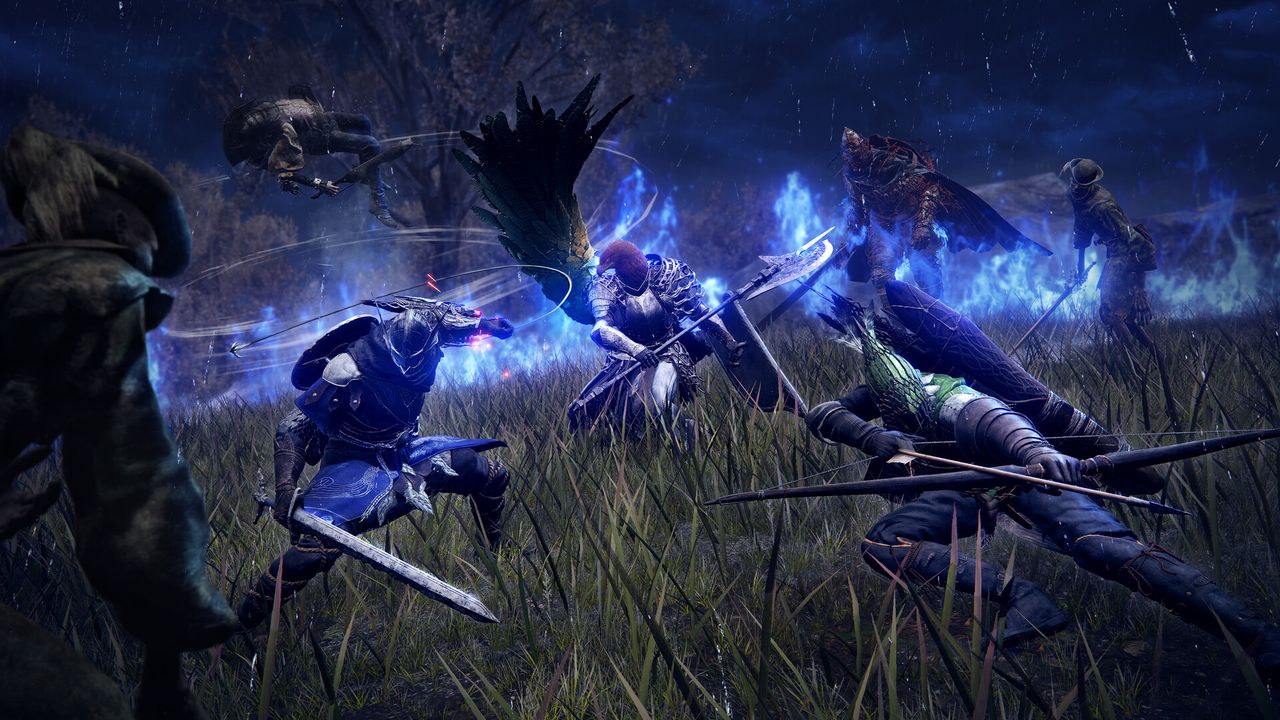
Elden Ring Nightreign — FromSoftware and Bandai Namco's co-op roguelike spin-off released May 30, 2025 — is built around three-player cooperative expeditions as its primary intended experience. Every Nightlord, every expedition type, and all progression rewards are fully available in multiplayer, and the game's revival system, stagger mechanics, and team role design are specifically tuned around a trio working together. This guide covers how to set up co-op with friends or with random matchmaking, the Duo Expeditions mode added in Patch 1.02 (July 31, 2025), how the downed-state revival mechanic works and why it shapes every boss fight, how to divide roles across three Nightfarers, and how to play effectively whether you are queuing with strangers or a coordinated group.
01How Co-op Expeditions Work
Nightreign's default mode is cooperative — when you select an expedition at the Table of Lost Grace, the game automatically queues you with up to two other players. The Roundtable Hold hub is always solo regardless of your matchmaking setting; your party only forms once all members confirm their Nightfarer selection and the expedition begins.
Co-op does not change the structure of a run: the same three-day loop, Night's Tide boundary, field bosses, and Day 3 Nightlord apply regardless of expedition size. What multiplayer changes is the resource economy and the survival safety net:
- Shared rune rewards: Every enemy killed by any party member grants runes to all three players simultaneously. There is no splitting — a kill benefits the whole team equally, meaning a well-coordinated trio levels faster per enemy cleared than three solo players would separately.
- Downed-state revival: When a player's HP reaches zero in a multiplayer expedition, they enter a near-death crawling state rather than immediately dying. Teammates can revive them by attacking them. This is the multiplayer equivalent of the Wending Grace self-resurrection item that exists only in solo mode — it is always available in co-op and does not need to be purchased.
- Trio HP scaling: In trio mode, enemies and Nightlords have their full base HP values. Solo mode reduces HP to approximately one-third, and duo mode sits between the two. The Nightlord boss guide covers the attack patterns and elemental weaknesses that apply to all party sizes.
All Nightlord rewards — including relic drops — are identical across party sizes. There is no progression advantage to playing solo over trio or vice versa.
02Setting Up Co-op: Matchmaking and Friend Invites
Nightreign offers two ways to form a co-op party: open random matchmaking and targeted friend-invite or password matchmaking.
Random matchmaking (default): The expedition type is set to multiplayer by default. Select your target Nightlord at the Table of Lost Grace and press Commence Expedition — the game places you in a queue until two other players are found, then launches the run automatically.
Friend invites: At the matchmaking settings screen, press R1 to navigate tabs and select Invite Members to send an invitation to anyone on your platform friends list. You can also generate a Share Link for players who are not yet on your friends list. After accepting the invite, invited players approach the Table of Lost Grace, confirm their Nightfarer, and the host commences the expedition.
Multiplayer passwords: For coordinating with a specific person without using the full invite system — or to reserve two slots with friends while leaving one open for a random third — enter a Multiplayer Password in the Matchmaking Settings tab and share the exact text with your partner. Passwords are case-sensitive. Any player with the same password entered becomes a priority match. To fill a duo with one random, set the password player count slider to two rather than three.
Three matchmaking restrictions are worth knowing before your first session:
- Tricephalos gate: Random matchmaking for all expeditions beyond Tricephalos requires you to have defeated Tricephalos at least once. Using the direct friend-invite system bypasses this restriction entirely, meaning an experienced friend can carry you through content you have not personally unlocked yet.
- Shifting Earth events: When a Shifting Earth rotating event is active, both you and any potential random matchmaking partner must have encountered that event in your own sessions to be matched together.
- Remembrance mode: Random matchmaking generally won't pair you with another player who also currently has a character Remembrance active. If you join a party via direct invite where more than one player has Remembrance active, only the lobby host's Remembrance objective progresses during that expedition — the other player's does not.
Your matchmaking settings persist between sessions — you do not need to reconfigure them each time you play.
03Duo Expeditions: 2-Player Co-op
Elden Ring Nightreign launched with three expedition configurations — solo, trio, and no two-player option. Duo mode was absent at release, with director Junya Ishizaki acknowledging it was "simply something that was overlooked during development." Patch 1.02 was originally scheduled for July 30, 2025, but Bandai Namco pushed it back a day to July 31 as a precaution after a tsunami warning following a major earthquake near Russia's Kamchatka Peninsula; it added Duo Expeditions once released, in direct response to player feedback about the difficulty of consistently finding a third player.
To start a duo expedition:
- Approach the Table of Lost Grace in the Roundtable Hold.
- Navigate to the Matchmaking Settings tab.
- Change the Number of Players setting to Duo (two players).
- Return to the Target tab, select your Nightlord, and press Commence Expedition.
Duo expeditions have boss HP and difficulty scaled between solo and full trio values. Boss staggering is easier to achieve with two players than three — the two-player stagger threshold is lower than trio, meaning coordinated damage breaks poise more frequently. FromSoftware has not published exact HP scaling percentages for duo mode.
The practical trade-off in duo mode is revival. Without a third player to draw boss aggro, reviving a downed partner during a Nightlord fight places full solo pressure on the remaining player: fight the boss or go for the revival. Team composition matters more in duo than trio — Guardian's Wings of Salvation (area revival that does not require standing over the downed body) is especially valuable when running with only one partner. The role division and team composition advice in the section below applies to duo with this constraint in mind.
04Downed State and Reviving Teammates
The revival mechanic is the single most important difference between co-op and solo play. Understanding it before your first multiplayer session prevents the most common source of full-party wipes.
When a player's HP reaches zero in a multiplayer expedition, they collapse into a near-death crawling state:
- Death gauge: A circular gauge divided into three segments appears above the downed player's head. Each segment represents one time this Nightfarer has been downed during the current run — the first knockdown uses one segment, the second uses a second segment, and so on. The more segments consumed, the larger the gauge becomes and the more attacks are needed for subsequent revivals. The gauge fully resets each time the team reaches a new Site of Grace.
- How to revive: Any teammate attacks the downed player — melee strikes, ranged bows, or spells all count. Each hit depletes the death gauge. When the gauge empties, the downed player stands up at approximately 50% HP. There is no special input or interaction prompt; any attack from any direction works.
- Ranged revival: You can revive a downed teammate at a distance using a bow or sorcery without standing directly over them. This is the preferred method during active Nightlord fights — ranged revival lets you stay mobile and avoid boss attacks rather than kneeling beside the downed player.
- If not revived in time: When the death gauge timer expires, the downed player respawns at the last Site of Grace they visited. They lose all runes they were carrying, which drop at the death location and can be retrieved — but they also lose any levels gained since that grace. The rest of the party continues the expedition with one fewer player.
- Full party wipe: If all players are simultaneously downed and none are revived before the last death gauge expires, the expedition ends immediately. Every player is returned to the Roundtable Hold and restarts from Day 1 at level 1 — the same consequence as a solo run-ending death. This is why prioritising revival over continued boss damage is almost always the correct decision in a team fight.
Two Nightfarers have ultimate abilities that bypass the standard attack-to-revive system:
- Guardian — Wings of Salvation: Creates a protective area and revives downed teammates within the radius without requiring a stream of attacks. Useful during phase-two Nightlord transitions when the arena is too dangerous to stand still attacking.
- Revenant — Immortal March: Revives all downed teammates in an area of effect radius simultaneously — capable of pulling up two downed players at the same time if a fight goes badly. Widely considered the game's most powerful panic button in a trio.
Running at least one Nightfarer with a revival ultimate is strongly recommended for every trio, particularly when learning a Nightlord for the first time.
05Role Division in a Trio
Each of Nightreign's eight base-game Nightfarers fills a distinct team function (The Forsaken Hollows DLC, released December 2025, added two additional Nightfarers — Scholar and Undertaker — see our Scholar & Undertaker build guide for their team roles). The most resilient trios bring at least one character from each of the following categories:
- Damage and stagger (Wylder, Raider, Executor, Duchess): These Nightfarers generate the bulk of the trio's DPS and poise damage. Raider's colossal weapon strikes are the most consistent stagger source; Executor's parry loop produces the highest single-target burst ceiling. Stagger is the trio's primary damage multiplier — when the boss's poise breaks, all three players should use their highest-damage ability or skill simultaneously rather than attacking independently.
- Ranged and utility (Ironeye): Ironeye's Eagle Eye passive increases item and relic drop rates for every member of the party, not just Ironeye. Marking creates a team-wide damage multiplier on the targeted enemy. In most trios, Ironeye contributes more total team value over a full expedition than any other single Nightfarer because the benefits compound across all three players.
- Healing (Recluse): Recluse is the only Nightfarer with a dedicated healing ultimate (Soulblood Song). In prolonged Nightlord fights — particularly bosses with high sustained damage output — Recluse's healing extends the window before the team exhausts Sacred Flasks.
- Revival and tank (Guardian, Revenant): Both have area revival ultimates. Guardian is also the team's most durable melee anchor, with Commander's Standard providing a party-wide attack buff aura. Revenant's spirit summons split Nightlord aggro, reducing damage taken by everyone by dividing the boss's attention.
The single most important co-op relic to equip is Flask Also Heals Allies: when any party member uses a Crimson Tears flask, 50% of the heal also applies to nearby teammates. In a well-grouped trio, one flask use can sustain multiple players through a Nightlord burst phase, effectively tripling your team's total healing throughput.
No trio needs to follow this template rigidly, but any group lacking both a healer and a reviver will struggle with phase-two wipes against harder Nightlords. The minimum viable pairing is one Nightfarer with a revival ultimate (Guardian or Revenant) plus enough DPS from the other two to end Nightlord phases before Flask reserves are gone.
06Playing with Randoms
Random matchmaking is the fastest route into an expedition but requires adapting to unknown teammates with no voice communication. Several principles make random runs significantly more consistent:
- Read the Nightfarer selection before committing: Before the expedition launches, you can see what Nightfarers your teammates have picked. If two players are already on melee damage dealers, your trio lacks ranged coverage and revival utility — pick Ironeye or Guardian to compensate. Covering gaps in the team's visible composition at selection is the highest-leverage decision available.
- Use map pings to communicate objectives: The map ping system is your primary communication tool in lieu of voice or text chat. Pinging a merchant, a Site of Grace, a field boss, or a rally point communicates your intention without words. Pin the most urgent objective early in each day so teammates can route towards it without confusion.
- Always revive before re-engaging the boss: When a teammate goes down during a Nightlord fight, the correct response in almost all cases is to break off from attacking and prioritise revival first. A 2v1 Nightlord fight is substantially harder than a 3v1 — the lost DPS from a revival pause is always less costly than the risk of a second knockdown turning into a full-party wipe.
- Move with the Night's Tide boundary: Players who split off when the Night's Tide circle is closing risk being caught outside alone. Check the minimap regularly in Days 1 and 2 and move in the same direction as your teammates rather than pursuing one more enemy group when time is short.
- Let teammates collect before moving on: Because rune rewards are shared across the party, waiting for a teammate to finish farming an enemy group costs you nothing — their kills add to your rune total too. Rushing to the next area before everyone has cleared nearby enemies slows the whole team's levelling pace.
07Tips for Coordinated Trios
When playing with friends over external voice chat, several high-value strategies become possible that are impractical without real-time communication:
- Agree on Nightfarers before queuing: The most effective coordinated trios designate roles before expedition start: one revival or healing Nightfarer (Guardian, Revenant, or Recluse), one utility ranged (Ironeye), and one or two damage dealers. Ironeye's Eagle Eye passive compounds across a full run and is worth prioritising whenever someone is comfortable playing ranged.
- Call Marking timing aloud: When Ironeye is in the party, the Marking player should verbally call the mark so all three players activate their highest-damage skills and abilities at the same moment. The combination of the Marking damage multiplier and a stagger window can collapse a Nightlord phase in seconds.
- Coordinate Duchess Restage: Duchess's Restage skill reapplies all damage dealt to the target in the previous three seconds at 50% of the original value, including ailment buildup and stance damage. To maximise it, a teammate (Wylder with a charged hit, or Ironeye using Single Shot ultimate) calls the heavy hit out loud; Duchess immediately activates Restage to replay that damage window. Without voice coordination this combo is unreliable; with it, it produces some of the game's highest burst output.
- Designate a revival priority player: If your trio includes Guardian or Revenant, that player's primary responsibility during Nightlord phase two is revival coverage — using Wings of Salvation or Immortal March the moment a teammate goes down rather than waiting to see if someone else handles it. Silence in a crisis leads to nobody acting.
- Split Day 1 routes deliberately: Unlike randoms who stay grouped by default, a coordinated trio can purposefully split early in Day 1 — one player routes toward a merchant, one toward a Site of Grace, one toward a field boss — then converge before the Night's Tide tightens. The shared rune pool means targeted splits maximise total runes and upgrades across the team before Day 2 and Day 3.
FAQ
Can you play Elden Ring Nightreign co-op with randoms?
Yes. The default expedition type is multiplayer, so queuing with randoms happens automatically — select your target Nightlord at the Table of Lost Grace and the game fills the remaining two slots from the matchmaking pool. The only restriction is that random matchmaking for expeditions beyond Tricephalos requires you to have defeated Tricephalos at least once in your own session. Using the direct friend-invite system bypasses this restriction entirely.
How does reviving work in Elden Ring Nightreign multiplayer?
When a player's HP reaches zero in a multiplayer expedition, they enter a near-death crawling state with a three-segment death gauge above their head. To revive them, any teammate attacks the downed player — melee, ranged, or magic all work — until the gauge empties, at which point the downed player stands up at approximately 50% HP. If the gauge timer expires before revival, the player respawns at the last Site of Grace, losing all runes carried (the runes drop at the death location for retrieval). The death gauge resets each time the team reaches a new Site of Grace. Guardian's Wings of Salvation and Revenant's Immortal March can also revive downed teammates directly via their ultimate abilities.
Can 2 people play Elden Ring Nightreign together?
Yes, since Patch 1.02 (released July 31, 2025, one day later than originally scheduled due to a tsunami-warning delay). Duo Expeditions allow exactly two players to run together without needing a third. To access it, navigate to the Matchmaking Settings tab in the Roundtable Hold and change the Number of Players setting to Duo before commencing your expedition. Duo mode has boss HP and difficulty scaled down from full trio values, and boss staggering is easier than in a three-player party.
Is Elden Ring Nightreign cross-platform or cross-play?
No. Elden Ring Nightreign does not support cross-platform play between PlayStation and Xbox. Cross-generation play within the same platform family is supported — PS4 and PS5 players can connect with each other, and Xbox One and Xbox Series X/S players can connect with each other — but a PlayStation player cannot join an Xbox party or vice versa.
What happens if all players die in Elden Ring Nightreign?
If all three players are downed simultaneously and none are revived before the final death gauge expires, the expedition ends immediately. All players are returned to the Roundtable Hold and the next run restarts from Day 1 at level 1. This makes revival the highest-priority action in a Nightlord fight — losing one player is recoverable, but a full-party wipe ends the run unconditionally.
Do you need to play Elden Ring Nightreign co-op, or can you go solo?
Solo play is fully supported. Change the Expedition Type to Single Player in the Matchmaking Settings at the Great Site of Grace. Solo mode scales enemy HP to approximately one-third of trio values, grants a 60% rune acquisition bonus, and provides access to the Wending Grace self-resurrection item — the solo equivalent of the multiplayer revival system. All Nightlords and progression rewards are available in solo mode. See the dedicated Solo Guide for a full breakdown of solo mechanics, the Wending Grace item, and the best Nightfarers for single-player runs.
Sources
Where the facts on this page were checked. If one of them now says something different, we want to know — tell us and we will fix the guide.
- ELDEN RING NIGHTREIGN – Patch Notes Version 1.02 Bandai Namco Entertainment America
- ELDEN RING NIGHTREIGN – Patch Notes Version 1.03 Bandai Namco Entertainment America
- ELDEN RING NIGHTREIGN – Hotfix 1.03.5 Bandai Namco Entertainment America
- Solo Play Fextralife
- Nightfarer Skills Fextralife
- Elden Ring Nightreign "Duos Mode" might be added via post-launch updates GosuGamers
New & updated guides ship every week. Follow the Atom feed or get notified when new Elden Ring Nightreign guides land.