Last updated: 5 September 2026
Best Farm Type in Stardew Valley — All 8 Compared
Choosing a farm type at the start of a new save is a one-way decision — Stardew Valley doesn't let you change your farm layout without starting a fresh save, so it's worth a few minutes of research before you commit. Here's what each of the 8 farm maps actually offers, roughly how much farmable land you get, and which playstyle each one rewards.
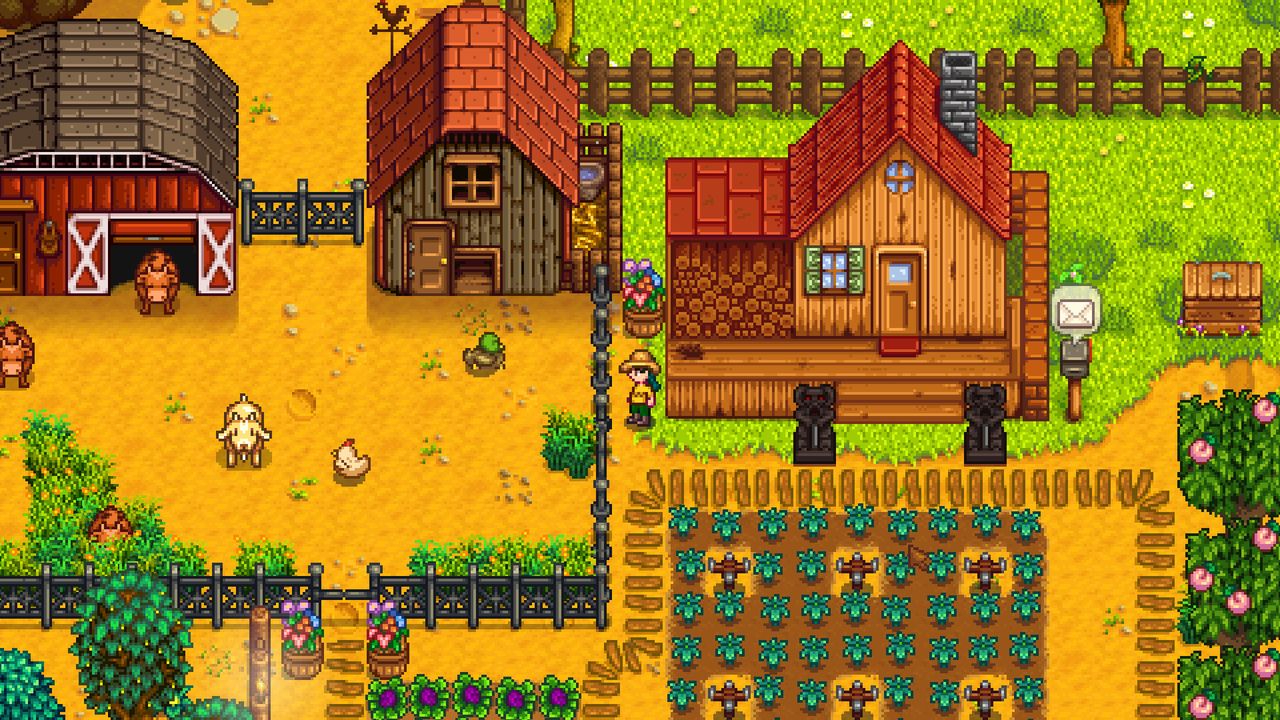
Standard Farm is the safest, most flexible pick for a first playthrough — the most open, tillable land (about 3,427 tiles) and no map gimmick to work around. Forest Farm and Meadowlands Farm are the strongest specialized picks: Forest for early foraging and free hardwood, Meadowlands for an animal-focused run with a head-start Coop and friendship-boosting blue grass. Four Corners is the best all-rounder for co-op groups who want to split up specialties.
01Quick Comparison
- Standard Farm — ~3,427 tillable tiles, the most of any map, with no special terrain gimmick. The default recommendation for new players.
- Four Corners Farm — ~2,952 tillable tiles split into four themed quadrants (farmland, forest, quarry, fishing pond) — built for multiplayer specialization.
- Beach Farm — ~2,700 tillable tiles, mostly sand where sprinklers don't work, but tide pools and washed-up supply crates add unique income.
- Wilderness Farm — ~2,131 tillable tiles; monsters spawn on your farm every night for free combat XP and drops, at the cost of early-game safety.
- Meadowlands Farm — ~2,066 tillable tiles, animal-focused: starts with a Coop and two chickens, plus friendship-boosting blue grass.
- Hill-top Farm — ~1,648 tillable tiles with a built-in mineable quarry area for ore, stone and geodes without leaving the farm.
- Riverland Farm — ~1,578 tillable tiles, well over half water — a fishing-focused layout with scattered islands.
- Forest Farm — ~1,413 tillable tiles, the least farmland but the most foraging: renewable hardwood, seasonal forage, and bushes that always drop Mixed Seeds.
02Standard Farm — Best for Beginners
Standard Farm has by far the most open, tillable land of any layout — around 3,427 tiles — and none of it is locked behind a map gimmick like water, forest clutter, or sand. If you're not sure yet what kind of playthrough you want (heavy crops, animals, or a mix), Standard removes the guesswork: you can lay out crops, coops, barns and sprinkler grids anywhere without planning around terrain.
The tradeoff is that it's the least interesting map visually and mechanically — there's no free resource node, no combat XP source, and no fishing hotspot built in. It's the right pick if you want maximum control over your layout rather than a themed bonus.
03Forest Farm — Best for Foraging
Forest Farm trades tillable land (the smallest of the 8 maps, at roughly 1,413 tiles) for a border that behaves like the Secret Woods: dense trees, seasonal forage items, and weeds that always drop Mixed Seeds when cut. Western clearings also regenerate Hardwood over time — normally a resource you'd otherwise need to travel to the Secret Woods or Ginger Island for.
This is a strong pick for a Forager-profession run, or for anyone who wants a steady early-game income from selling forage without much crop investment. It's a poor choice if your goal is maximizing crop output, since the reduced tillable space caps how large your fields can grow.
04Riverland Farm — Best for Fishing
Riverland Farm is dominated by water — interconnected rivers and small islands cover well over half the map — turning your own farm into a fishing spot without a trip to town. Tillable land drops to around 1,578 tiles, spread across the islands rather than one open field, which makes sprinkler layouts and crop-grid planning noticeably more fiddly.
It's a great pick if fishing is a priority skill for you early on, since you can level it up without leaving home. For crop-focused players, the fragmented land makes this one of the harder maps to optimize.
05Hill-top Farm — Built-in Mining
Hill-top Farm includes a small quarry area in the southwest corner where stone, ore and geode nodes spawn based on your Mining skill level — effectively a free, renewable mining spot on your own property. Tillable land sits around 1,648 tiles.
This suits players who want a steady ore supply for tools, buildings, and Krobus/Blacksmith crafting without repeated Mines trips, though it won't replace the Mines or Skull Cavern for late-game ore and geode volume.
06Wilderness Farm — Free Combat XP (With a Catch)
Wilderness Farm spawns monsters directly on your farm every night, identical to what you'd fight in the Mines, and scaling in difficulty with your combat level (with tougher Iridium Golems joining the mix once you hit Combat Level 9). Kills grant combat XP (at roughly a third of the normal rate) and count toward monster-eradication goals, giving you a passive source of combat leveling and drop farming without leaving home. Tillable land is about 2,131 tiles.
The obvious catch: nighttime monsters near your crops and animals are a real risk for a new player without decent gear, so this layout rewards players who already have some combat experience rather than total beginners.
07Beach Farm — Coastal Bonuses, Awkward Watering
Beach Farm covers most of its ~2,700 tillable tiles in sand, which blocks sprinklers from working — you'll be watering crops by hand (or a Watering Can upgrade) for the entire playthrough on that terrain. In exchange, tide pools at the east end of the map are a steady source of Coral and Sea Urchins, and supply crates wash ashore periodically with random loot ranging from mixed seeds to rare artifacts.
It's a fun, thematic choice if you enjoy the coastal aesthetic and don't mind the extra manual watering, but the sprinkler restriction makes it one of the more labor-intensive maps for pure crop-scaling.
08Four Corners Farm — Best for Co-op
Four Corners splits roughly 2,952 tillable tiles into four themed quadrants: a Standard-style farmland section, a Forest-style corner with trees and a stump, a Hill-top-style mini quarry, and a Riverland-style fishing pond. Each quadrant is small on its own, but together they let a multiplayer group split up by specialty — one player mining, one fishing, one foraging, one farming — without anyone stepping on another's setup.
For solo players it still works as a "sampler" of every other map's gimmick in miniature, though none of the four sections is as strong individually as the dedicated map it's based on.
09Meadowlands Farm — Best for Animal Husbandry
Meadowlands Farm, added in the 1.6 update, is built specifically around raising animals. New saves on this map start with a small Coop and two chickens already in place (instead of the usual starting Parsnip Seeds), and much of the terrain is covered in Blue Grass — a renewable grass type that animals love, and which increases friendship gain from grazing on it. Tillable land is around 2,066 tiles, with a lot of the remaining space occupied by non-farmable grass patches.
This is the clear pick if your goal is an animal-focused run — Blue Grass alone gives Meadowlands an edge for coop and barn animal happiness that no other map replicates. It's a weaker choice if your priority is maximizing crop yield, since a meaningful chunk of the map isn't tillable at all.
10Can You Change Your Farm Type Later?
No — the farm map is locked in permanently when you create a new save and can't be changed afterward without starting a new farm entirely (or using an unofficial third-party save-editing tool, which isn't officially supported and can affect other save data). If you're torn between two types, it's worth deciding based on the playstyle you actually want for that specific save rather than picking whichever has marginally more tillable tiles — a Forest or Meadowlands run built around its gimmick tends to be more memorable than a maxed-out Standard Farm spreadsheet.
FAQ
What is the best farm type for beginners in Stardew Valley?
Standard Farm is the recommended pick for a first playthrough. It has the most tillable land of any map (around 3,427 tiles) and no special terrain gimmick to plan around, so you can focus on learning the game's core systems without also working around water, sand, or forest clutter.
What is the Meadowlands Farm and is it good?
Meadowlands Farm, added in the 1.6 update, is built around animal husbandry — you start with a Coop and two chickens instead of Parsnip Seeds, and much of the map is covered in Blue Grass, which animals love and which boosts friendship gain faster than regular grass. It's an excellent pick if you're planning an animal-focused run, but weaker for maximizing crop output since a large portion of the map isn't tillable.
Which Stardew Valley farm has the most tillable land?
Standard Farm has the most tillable land at roughly 3,427 tiles, followed by Four Corners Farm (~2,952) and Beach Farm (~2,700). Forest Farm has the least at around 1,413 tillable tiles, trading farmland for foraging bonuses.
Can I change my farm type after starting a save?
No. The farm map is set permanently when you create a new save file and cannot be changed later without starting an entirely new farm. Think through your preferred playstyle before confirming your farm type at the start screen.
Is Four Corners Farm good for solo players?
It can work as a sampler of every map's gimmick — a small farmland section, a forest corner, a mini quarry, and a fishing pond — but each quadrant is smaller and less developed than the dedicated map it's based on. It's primarily designed for multiplayer groups who want to split up by specialty, and shines most in that context.
Sources
Where the facts on this page were checked. If one of them now says something different, we want to know — tell us and we will fix the guide.
New & updated guides ship every week. Follow the Atom feed or get notified when new Stardew Valley guides land.