Last updated: 19 October 2026
Does Fortune's Weave Have Romance and Supports?
Now that Fire Emblem: Fortune's Weave has launched, the question this guide tracked before release has an answer: support conversations exist — you build bonds with allies during free-time segments between tournament matches, in a structure similar to Three Houses' monastery exploration — but there is no S-rank romance or marriage system. Multiple launch-week outlets, including Video Games Chronicle's FAQ coverage, confirm the cast is unusually flirtatious but that no support rank seals a relationship the way Three Houses' or Awakening's S-rank did. Here is what the released game actually does, what reviewers flagged as a letdown, and how Fortune's Weave fits into the series' long history of relationship mechanics.
01Confirmed: Support Conversations and Free Time, No S-Rank Romance
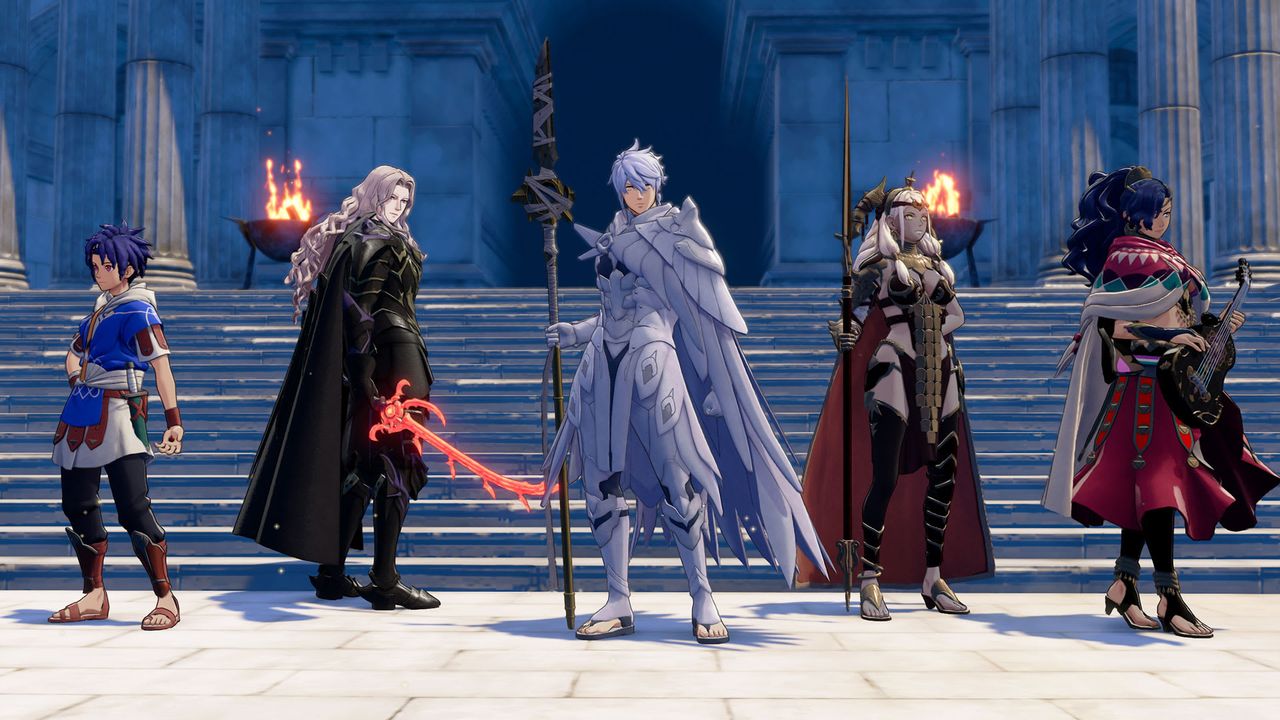
Fire Emblem: Fortune's Weave includes free-time segments between tournament matches, where you explore the arena grounds and the surrounding city of Dagsion to develop bonds with allies, learn about Dagda's culture, and prepare for upcoming battles. Support conversations are a real part of that loop — including, for example, exchanges between Cai and his childhood friend Tiara, a strategist whose support role boosts ally stats and recovers struggling comrades with magic.
What launch coverage settled is the bigger question this guide used to leave open: there is no S-rank, no marriage, and no romance mechanic comparable to Three Houses or Awakening. Video Games Chronicle's FAQ on the game states plainly that there are no S-rank conversations tied to a true romance system, even though the cast is written as some of the most flirtatious in the series' history — flirtation is a tone, not a mechanic that leads anywhere. A French-language guide (Gameblog) reports the same conclusion independently: no active romance, no marriage, no couples to seal with a final support rank.
Reviewers were not uniformly happy with that choice. Siliconera's review calls the support system one of the game's weaker points, noting many characters get only minimal support conversations — a step back from the depth Three Houses offered — and that Eshmel, the avatar protagonist, feels somewhat disconnected from the cast because the time-travelling hero only becomes central to the story in the campaign's third part.
02What Support Actually Looks Like In the Released Game
Fortune's Weave keeps a numbered support-rank structure rather than Three Houses' C/B/A/S letters, but sourcing on the exact scale conflicts: some guides describe ranks climbing from 1 to 5 with a top rank reserved for conversations involving Eshmel, the player-avatar protagonist, while other community references describe conversations topping out around rank 3 with no higher tier for anyone, Eshmel included. Neither account traces back to an official source, so treat the specific numbering as unresolved — it doesn't change the broader "no romance payoff" conclusion above, which is well-corroborated independently.
The four separate protagonist routes — Cai, Dietrich, Theodora, and Leda, each leading their own storyline — do mean support options and available partners differ by route, consistent with what multiple pre-release previews expected given the four-lead structure. Whether every protagonist has an equally deep support roster is not something this guide has verified route-by-route; reviewers flagged the overall amount of support content, not a specific route, as thinner than Three Houses.
03Series Precedent: How Fire Emblem Has Handled Romance Before
Fire Emblem's relationship systems have evolved significantly across the modern era of the franchise, ranging from full marriage-and-children mechanics to a significantly restrained friendship approach. The four most recent home console entries show the range:
- Fire Emblem Awakening (2013) — Introduced the modern marriage system to the series in full. Characters reach S-rank support with the protagonist (Robin) or with each other, triggering a marriage. Married couples produce children who become playable units, inheriting stats and skills from their parents. Awakening's pairing system was a defining feature of its identity and became one of the most discussed mechanics in the franchise.
- Fire Emblem Fates (2015/2016) — Expanded on Awakening's approach. S-rank support leads to marriage; married characters produce children recruitable through special missions. Same-gender marriage options were included, though same-gender couples could not recruit children. The mechanic was central to gameplay as well as story, since parent stats directly shaped children's potential.
- Fire Emblem: Three Houses (2019) — Supports use a C/B/A/S rank structure. The player character Byleth can pursue an S-rank romance with one character per playthrough; the scene and paired ending are unlocked near the game's end rather than during it. No children mechanic. Three Houses offered the widest range of romance-compatible characters in the series' history to that point, including same-gender options, and the depth of A-rank support scenes made character relationships a centrepiece of the experience even for players who skipped S-rank entirely.
- Fire Emblem Engage (2023) — Took a noticeably restrained approach. A Pact Ring item becomes available after Chapter 22, and giving it to an ally functions as a relationship declaration. Romantic Pact Ring scenes exist for a substantial portion of the eligible cast, but the overall tone is more subdued and ambiguous than Three Houses — and the English localisation ensured that characters who are underaged receive only a platonic scene. No children mechanic. Engage's restrained relationship system proved divisive; some fans appreciated the tonal shift, others missed the romance depth of Three Houses.
Three Houses and Engage — the two most recent entries — sit at opposite ends of that spectrum, and Fortune's Weave lands closer to Engage: present and talked about in the writing, but with no mechanical payoff like Awakening's or Three Houses' S-rank.
04Why Fortune's Weave Skipped Romance
Three Houses' relationship system worked in part because it had a single player avatar — Byleth — whose entire social world could be built around one consistent cast over an academic year at a monastery. Fortune's Weave instead splits across four player characters, each with their own protagonist route, allies, and rivals, inside a tournament structure rather than a school year. Building a Three Houses-style romance system that works consistently across four separate leads — and a fifth time-travelling avatar in Eshmel — would have been a substantially more complex design problem than giving Byleth one unified support web.
Eshmel — the customizable, dual-gender hero confirmed at the August 4, 2026 Nintendo Direct as the game's true protagonist — ended up being part of the explanation reviewers gave for the thinner support content, rather than a workaround for it. Because the game's time-travel framing only puts Eshmel at the center of the story in its third act, Siliconera's review specifically called out Eshmel feeling disconnected from the cast for much of the game, which likely limited how much of a dedicated Eshmel support/romance web Intelligent Systems could build around a character who is absent from large stretches of the story.
None of the launch coverage frames the lack of romance as a bug or an oversight — it reads as a deliberate scope decision given the four-protagonist structure, consistent with Engage's similarly restrained approach after Three Houses' far larger romance system.
05The Bottom Line
If you were waiting to find out whether Fortune's Weave has a Three Houses-style romance system before buying: it does not. What it has is confirmed, and worth setting expectations around:
- Support conversations exist and build character relationships during free time, following each protagonist's individual roster of allies.
- No S-rank, no marriage, no children mechanic — nothing comparable to Awakening, Fates, or Three Houses' S-rank romance.
- Flirtatious writing, not a romance payoff — multiple launch-week outlets independently describe the cast as unusually flirtatious without that tone leading to a relationship mechanic.
- Reviewers flagged support depth as a step down from Three Houses, not as a feature previewers failed to find.
Players specifically looking for Fire Emblem's marriage-and-children systems should look to Awakening or Fates instead; players who enjoyed Engage's lighter touch on relationships will find Fortune's Weave closer to that end of the series' range.
FAQ
Does Fire Emblem: Fortune's Weave have romance?
No, not as a mechanic. Fire Emblem: Fortune's Weave has support conversations — you build bonds with allies during free-time segments between tournament matches — and the cast is written with an unusually flirtatious tone, but launch-week coverage (Video Games Chronicle's FAQ, and independently a Gameblog guide) confirms there is no S-rank conversation, marriage, or romance system that pairs characters off.
Are support conversations confirmed in Fire Emblem: Fortune's Weave?
Yes. Free-time segments between tournament matches let you build support bonds with allies, including an exchange between Cai and his childhood friend Tiara. Reviewers of the finished game, including Siliconera, note that overall support content is thinner than Three Houses offered, with several characters getting only minimal conversations.
Does Fortune's Weave have marriage and children like Fire Emblem Awakening or Fates?
No. There is no S-rank, no marriage, and no children mechanic in Fortune's Weave. Awakening and Fates both featured S-rank marriage leading to recruitable child units — a mechanic already absent from Three Houses (2019) and Engage (2023) — and Fortune's Weave continues that more restrained direction rather than reviving it.
How does Fortune's Weave compare to Three Houses for supports and romance?
Three Houses had an extensive C/B/A/S support system where Byleth, its single protagonist, could pursue S-rank romance with one character per route. Fortune's Weave has support conversations across its four separate protagonist routes, but no romance payoff at any rank, and reviewers describe the support content overall as a step down from Three Houses in depth — closer to Engage's more restrained approach than to Three Houses' or Awakening's relationship systems.
Sources
Where the facts on this page were checked. If one of them now says something different, we want to know — tell us and we will fix the guide.
- Fire Emblem: Fortune's Weave — Nintendo Direct 8.4.2026 Nintendo
- Fire Emblem: Fortune's Weave for Nintendo Switch 2 Nintendo
- Fire Emblem: Fortune's Weave Wikipedia
- Fire Emblem: Fortune's Weave Direct Reveals True Protagonist and Plot Game Informer
- Fortune's Weave: August Direct Analysis - Characters Serenes Forest
- Fire Emblem: Fortune's Weave Characters - List of all of the playable characters, villains, and more so far RPG Site
- Fire Emblem: Fortune's Weave Officially Confirms Eshmel Is The "True Protagonist" TheGamer
- Fire Emblem: Fortune's Weave clips showcase Tiara and Cai GoNintendo
- Fire Emblem Fortune's Weave FAQ: The biggest questions answered Video Games Chronicle
- Fire Emblem: Fortune's Weave — romance Gameblog
- Review: Fire Emblem: Fortune's Weave Is a Massive Epic Siliconera
New & updated guides ship every week. Follow the Atom feed or get notified when new Fire Emblem: Fortune's Weave guides land.