Last updated: 5 September 2026
Balatro Deck Builds Archetypes Explained
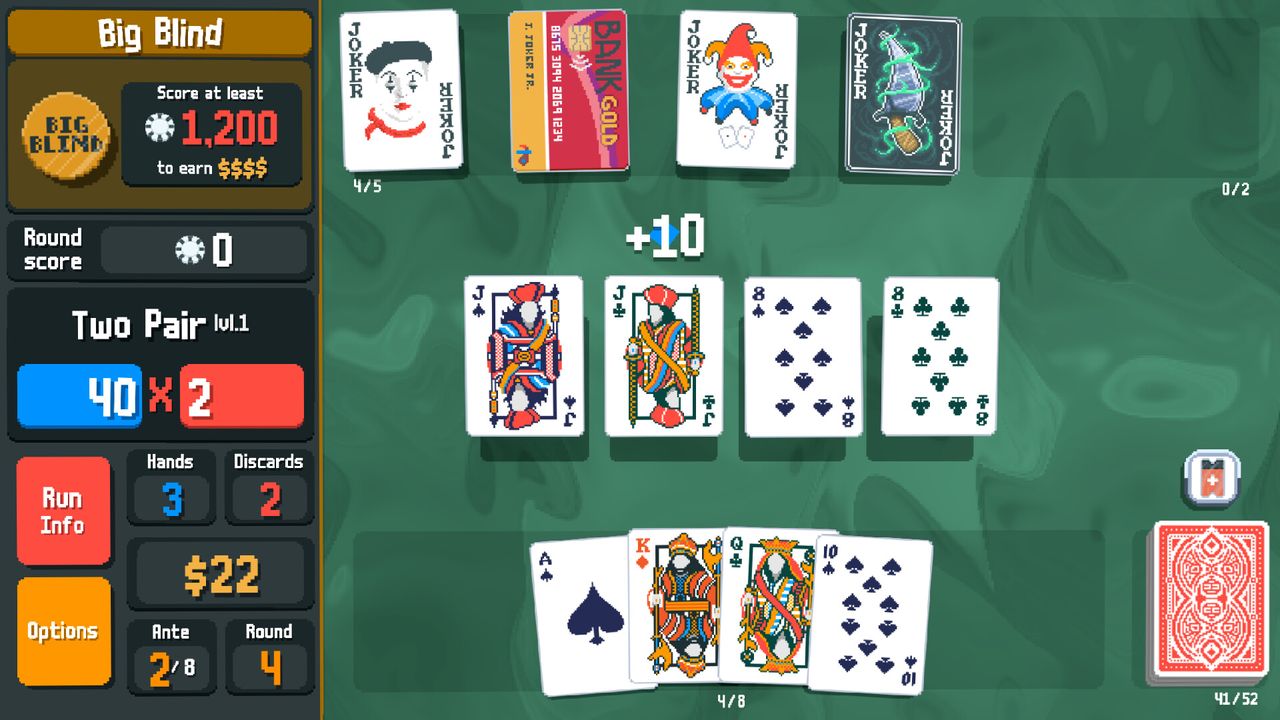
Every winning Balatro run has the same spine: one hand type you commit to, a Planet card steadily leveling it, and a Joker lineup purpose-built around it. Runs that stall or die early almost always lack that commitment — a mix of situational Jokers that don't quite connect. This guide covers the three main archetypes, how to recognize which one the shop is steering you toward, and how deck thinning and Planet cards lock it in from Ante 1 to Ante 8.
01One Hand, One Focus
Balatro's scoring is multiplicative: a Flush leveled four times with Jupiter and supported by two dedicated Jokers will massively outscore a player splitting Joker slots and Planet cards between Flush and Pair — even if the split player has individually stronger cards.
The practical question in every shop is: does this Joker belong in my build, or is it a distraction? You can only answer that once you've named your archetype. Before Ante 2, keep your options open and watch what the shop offers. Once a clear pattern emerges, commit hard. By Ante 4, a run without a focused strategy almost never clears Ante 8.
The three archetypes below cover the vast majority of winning runs. Because the shop is random, the right build for a given run is always the one the game is enabling — not the one you decided at the character select screen.
02Archetype Overview
03Archetype 1 — Flush Build (Beginner-Friendly)
A Flush (five cards of the same suit) has a base score of 35 Chips × 4 Mult and is the most forgiving archetype to start with. The condition — matching suit — is instantly visible from your hand, the supporting Jokers are cheap and Common, and the Checkered Deck starting option (Hearts and Spades only) makes Flushes nearly automatic from the very first Ante.
Core components to build around:
- Jupiter (Planet card) — permanently levels the Flush hand every time you use one. This is the most important card in a Flush build; buy it without hesitation every time the shop offers one.
- Four Fingers (Joker, Uncommon) — lets Flushes be completed with only four cards instead of five. This frees one card slot and dramatically increases how often a random draw produces a valid Flush.
- Smeared Joker (Joker, Uncommon) — makes all red cards count as each other and all black cards count as each other for suit matching, effectively collapsing the deck into two suits. Combined with the Checkered Deck, nearly every five-card hand is a Flush.
- Suit Jokers (Common) — Greedy Joker (Diamonds), Lusty Joker (Hearts), Wrathful Joker (Spades), and Gluttonous Joker (Clubs) each give +3 Mult per card of their suit that scores. Stack two or three of these for your primary suit.
Main weakness: several Boss Blinds specifically target Flush builds. The Hook discards two random cards of one suit mid-play, and The Arm lowers the level of any hand you play. Plan for these encounters with a Blind-skip voucher, or keep a fallback hand leveled enough to get you through.
04Archetype 2 — Pair and Trips Scaling
Pair builds focus on One Pair or Three of a Kind played every hand, scaled steadily with Mercury and Venus Planet cards. They're the most forgiving archetype because Pairs are always easy to form — no suit condition, no rank sequence. This also frees resources normally spent on deck thinning, so you can keep your cash near the $25 interest cap more consistently and invest in economy Jokers earlier.
Core components:
- Mercury (Planet card) — permanently levels One Pair. Stacking Mercury through mid-Antes is the primary scaling engine; without it, Pairs fall behind the Blind score requirements by Ante 6.
- Venus (Planet card) — permanently levels Three of a Kind, your natural fallback when you can't assemble a clean Pair.
- Jolly Joker (Common) — gives +8 Mult every time you play a Pair, unconditionally. One of the most reliable early-run Jokers for this archetype and should be bought on sight.
- Zany Joker (Common) — gives +12 Mult when Three of a Kind is played, a direct upgrade from Jolly if Trips become your primary hand.
- Sly Joker (Common) — adds +50 Chips when a Pair is played, padding the Chips side of your score while Planet cards handle Mult scaling.
Pair builds reward disciplined money management. Two economy Jokers plus two scoring Jokers is a typical Ante 4–6 lineup — buy a money Joker first, let interest income accumulate, then pivot toward scoring Jokers once the $25 cap is reliably maintained.
05Archetype 3 — Straight Builds
A Straight (five sequential ranks) starts at 30 Chips × 4 Mult, similar to Flush on the surface, but it scales differently: the raw rank values of cards in a Straight (a 10-J-Q-K-A Straight contributes the rank values of all five cards to the Chips total) give Straight builds a very high Chip ceiling in the late Antes that Flush builds can't match. Saturn Planet cards amplify this further.
The trade-off: Straights need specific rank combinations, making this archetype the most reliant on deck thinning. The key enablers make this manageable:
- Saturn (Planet card) — permanently levels the Straight hand. Buy it every time a Celestial Pack or the shop offers one.
- Shortcut (Joker, Uncommon) — the single most important Straight Joker. Allows Straights to be formed with one rank gap between cards (for example, A-3-5-7-9 counts as a valid Straight). Transforms Straights from conditional to consistently hittable.
- Four Fingers (Joker, Uncommon) — reduces the Straight requirement to four cards, freeing one held-in-hand slot and making the hand even easier to assemble.
- Runner (Joker, Common) — gains +15 Chips permanently every time a Straight scores. Starts slow but compounds significantly — a Runner bought in Ante 2 has accumulated hundreds of Chips by Ante 7.
- Fibonacci (Joker, Uncommon) — gives +8 Mult for each Ace, 2, 3, 5, or 8 that scores, which pairs naturally with sequences leaning on low ranks.
If Shortcut and Four Fingers both appear before Ante 3, that's a strong signal to commit to Straight as your primary archetype, even if you started the run trending toward Flush.
06Advanced: Steel and High-Card Builds
High-Card builds are atypical and advanced, but they have one of the highest scoring ceilings in the game. The mechanic relies on cards held in hand (not played) passively triggering Joker effects — and certain Jokers are powerful enough in the held-in-hand position that playing a single High Card becomes the optimal move every hand.
Key pieces for this archetype:
- Baron (Joker, Rare) — each King held in hand grants ×1.5 Mult at the end of scoring. With four Kings held simultaneously, that's ×1.5 applied four times — roughly a 5× Mult multiplier (1.5⁴ ≈ 5.06) before any other Jokers fire.
- Mime (Joker, Uncommon) — retriggers all held-in-hand card effects once. Mime effectively doubles every Baron trigger from held Kings, turning ×5 Mult into over ×25 Mult from cards you never even played.
- Steel enhancement (via The Chariot Tarot card) — each Steel card held in hand grants ×1.5 Mult. A hand of Steel-enhanced Kings with Baron and Mime active reaches astronomical totals before a single card is scored.
- Pluto (Planet card) — levels High Card to keep base Chips viable, since High Card's default base (5 Chips × 1 Mult) is far too low to clear mid-Antes without Planet investment.
This isn't a build to plan from the start screen. If you see Baron appear in the shop before Ante 4, evaluate whether you can buy every The Chariot Tarot you see going forward. Recognizing when the shop is handing you this build is the mark of an experienced player.
07Deck Thinning: Smaller Is Almost Always Better
Every archetype benefits from a smaller deck. A Flush build needs five Hearts from a single draw — your odds from a standard 52-card deck with 13 Hearts are workable but not great. Remove sixteen off-suit cards and your deck is 36 cards with the same 13 Hearts; now your draw quality is dramatically higher.
Two main methods for deck thinning:
- The Hanged Man (Tarot card) — permanently destroys up to 2 selected cards from your hand. This is the primary targeted thinning tool. Use it to remove cards that will never contribute to your archetype: off-suit cards for Flush builds, rank blockers for Straight builds, anything that clogs your draws.
- Arcana packs — buying Arcana packs gives more chances to find The Hanged Man and other Tarot cards that modify or remove cards. Prioritize them if you're in a build that needs tight deck composition.
A rough target: by Ante 4–5, aim to have 40 cards or fewer. By Ante 6+, competitive runs often operate on 28–36 card decks. Removing cards that were never going to trigger your hand type or Jokers doesn't weaken the deck — it makes every draw more valuable.
Don't think of thinning as losing cards. You're removing dead draws that were already working against you. A 32-card deck where every card earns its slot is far stronger than a 52-card deck where a third of the draws waste a turn.
08Planet Cards Lock In Your Archetype
Planet cards permanently boost a specific poker hand type's base Chips and Mult for the rest of the run. Each archetype has one Planet card you should prioritize above almost everything else:
- Jupiter → Flush
- Saturn → Straight
- Mercury → One Pair
- Venus → Three of a Kind
- Pluto → High Card
- Earth → Full House
- Mars → Four of a Kind
- Uranus → Two Pair
Whenever your archetype's Planet card appears in the shop or a Celestial Pack, buying it is almost always correct — the bonus stacks permanently and never expires. The High Priestess Tarot card adds two random Planet cards to your hand, which is particularly valuable if you get lucky and draw two copies of your archetype's Planet in a single use.
09Reading the Shop: When to Commit or Pivot
The most common intermediate mistake is locking into an archetype before the shop gives you a reason to. The right build for a run emerges from what the game is offering — if Ante 1's shop has two Flush-enabling Jokers, lean Flush. If the first Celestial Pack has three Mercury cards, lean Pair.
Signs that a pivot is worth considering:
- You've reached Ante 4 and the shop has not offered a single Joker that fits your current hand type.
- A powerful anchor Joker for a different archetype appears early — Shortcut when you're running Flush, or Baron when you're running Straight.
- A Boss Blind has hard-countered your primary hand type two Antes in a row and you keep barely scraping through on discards.
Pivoting is expensive: Planet card levels don't transfer between hand types. Mercury levels you invested in Pair don't carry over to Saturn for Straight. This is why pivoting is only usually correct before Ante 4. After Ante 5, patching your current strategy — extra discards, Blind-skip vouchers, shoring up weak Joker slots — is cheaper than rebuilding the entire plan.
FAQ
What's the easiest Balatro deck build for beginners?
Flush is the most reliable starting point. The condition (five cards of the same suit) is immediately visible, cheap Common Jokers support it directly, and the Checkered Deck starting option makes Flushes nearly automatic from the first Ante. Stack Jupiter Planet cards whenever the shop offers them.
How many cards should my Balatro deck have by mid-game?
A competitive mid-game deck (Antes 4–6) usually sits around 36–44 cards after thinning from the starting 52. By the final Antes, strong runs often get down to 28–36 cards. Smaller decks are almost always better since you see your important cards more consistently and waste fewer draws on off-type cards.
Which Planet card should I buy first in Balatro?
Match it to your archetype: Jupiter for Flush builds, Saturn for Straight builds, Mercury for Pair builds, Venus for Trips builds. Your archetype's Planet card is almost always worth buying on sight because the bonus stacks permanently for the rest of the run.
Can I run two hand types at once in Balatro?
Occasionally yes, but it's harder than it looks. Splitting Planet card investment between two hand types usually leaves both too weak for Ante 7–8. The cleanest hybrid is Pair plus Trips (Mercury and Venus), since both hands share similar Joker synergies and are played from the same general card shape. Flush and Straight hybrids are much harder to support simultaneously.
What does Shortcut do in Balatro and why is it so good for Straight builds?
Shortcut is an Uncommon Joker that allows Straights to be formed even with one rank gap in the sequence — so A-3-5-7-9 counts as a valid Straight. This transforms the Straight hand from conditional (needing five exact sequential ranks) into something you can reliably hit from a random draw, making it the single most important Joker for Straight archetypes.
When should I pivot my Balatro build mid-run?
Pivot before Ante 4 if you're going to pivot at all, since Planet card levels don't transfer between hand types. The best trigger for a pivot is finding a powerful anchor Joker for a different archetype early enough to build around it. After Ante 5, patching your current strategy with discards or Blind-skip vouchers is usually cheaper than restructuring the entire build.
Sources
Where the facts on this page were checked. If one of them now says something different, we want to know — tell us and we will fix the guide.
- Poker Hands Balatro Wiki (wiki.gg)
- Jokers Balatro Wiki (wiki.gg)
- Checkered Deck Balatro Wiki (wiki.gg)
- The Hanged Man Balatro Wiki (wiki.gg)
- The High Priestess Balatro Wiki (wiki.gg)
- The Chariot Balatro Wiki (wiki.gg)
New & updated guides ship every week. Follow the Atom feed or get notified when new Balatro guides land.