Last updated: 5 September 2026
Your Palico and Seikret Companion Guide
Two companions ride out with you on every hunt in Monster Hunter Wilds: the Palico, a cat-like fighter that heals, traps, and buffs, and the Seikret, a bird mount that carries your second weapon loadout and pulls you out of danger. Understanding both dramatically cuts cart risk and opens up advanced weapon-swapping strategies unavailable in any previous Monster Hunter title.
01What Your Palico Actually Does
The Palico is an AI-controlled companion that fights alongside you, using a rotation of Support Moves on cooldowns. In Wilds it has a meaningful role: it can shorten hunts, rescue you from status effects, and supply free healing in fights where every potion counts. The Palico equips its own weapon, head armour, and chest armour — all craftable at the Smithy — so its stats scale with your progression.
Beyond combat, the Palico gathers materials from the environment during hunts, returns to you after a short timer if it falls in battle, and builds rapport with you over time.
02The Five Palico Support Types
When you create or change your Palico you choose one of five Support Types, which determine which moves it prioritises and how it behaves. Three are combat-focused, and two support you outside of combat:
- Healer — prioritises survival tools that restore Hunter HP on demand and clear status ailments. Against punishing monsters, a Healer Palico can save many potions per hunt.
- Fighter — leans into buffs and crowd control, granting stamina and attack buffs and creating knockdown windows. A Fighter Palico with a buff-melody gadget and a paralysis weapon is widely considered a strong all-round pick.
- Bombardier — deals explosive damage with barrel bombs and stagger-heavy gadgets. Pairs well with Gunlance or Charge Blade hunts where staggering an armoured monster opens burst windows.
- Gathering — focuses on collecting materials, ingredients, and crafting resources for you during a hunt rather than fighting directly.
- Assist — supports exploration and utility tasks such as setting traps, rounding out the non-combat side of the roster.
Because the Palico cycles through moves on cooldown, builds that pair high-value moves together tend to outperform random selections. You unlock additional Support Moves gradually as you progress and complete certain quests. This guide focuses on the three combat Support Types (Healer, Fighter, Bombardier), since those matter most for surviving and speeding up hunts.
03Key Palico Support Moves to Prioritise
Not every Support Move is worth a slot. The following categories are consistently rated highest-impact, so prioritise the quests that unlock them:
- Healing delivery — sends a healing insect to restore a meaningful portion of Hunter HP. The Healer type uses this more frequently.
- Buff melody — plays a tune that grants attack power, stamina, and other buffs to the Hunter; one of the highest damage-uptime moves in the game on the Fighter type.
- Provoke — forces the monster to target the Palico for several seconds, giving you a free attack window or an escape route. Underrated in solo play.
- Status cleanse — clears poison, sleep, paralysis, and other debuffs, invaluable against status-heavy monsters.
- Steal extra parts — a gadget that pulls additional materials directly from the monster during combat, excellent for farming low-drop-rate parts.
04How to Craft and Upgrade Palico Gear
Palico equipment follows the same system as Hunter armour — visit Gemma at the Smithy and select Forge Palico Equipment. Each set consists of a weapon, head armour, and chest armour, crafted from monster materials. Palico gear typically needs fewer parts per item than Hunter sets, so it is faster to build.
Upgrading works identically: spend Armor Spheres to raise defense. Prioritise upgrading the Palico weapon first, since higher attack translates into better status application and more frequent heal and paralysis windows for you.
- Hunt the target monster to collect its parts.
- Return to base camp and speak to Gemma at the Smithy.
- Select Forge Palico Equipment and craft the weapon, head, and chest separately.
- Use Upgrade Equipment and spend Armor Spheres on the pieces you crafted.
- Open the Palico menu and equip the new gear.
Keep Palico gear within a tier or two of your own — a Palico in undergeared armour deals less status, heals slower, and faints more often, costing you support every hunt.
05The Seikret: What It Is and Why It Changes Hunts
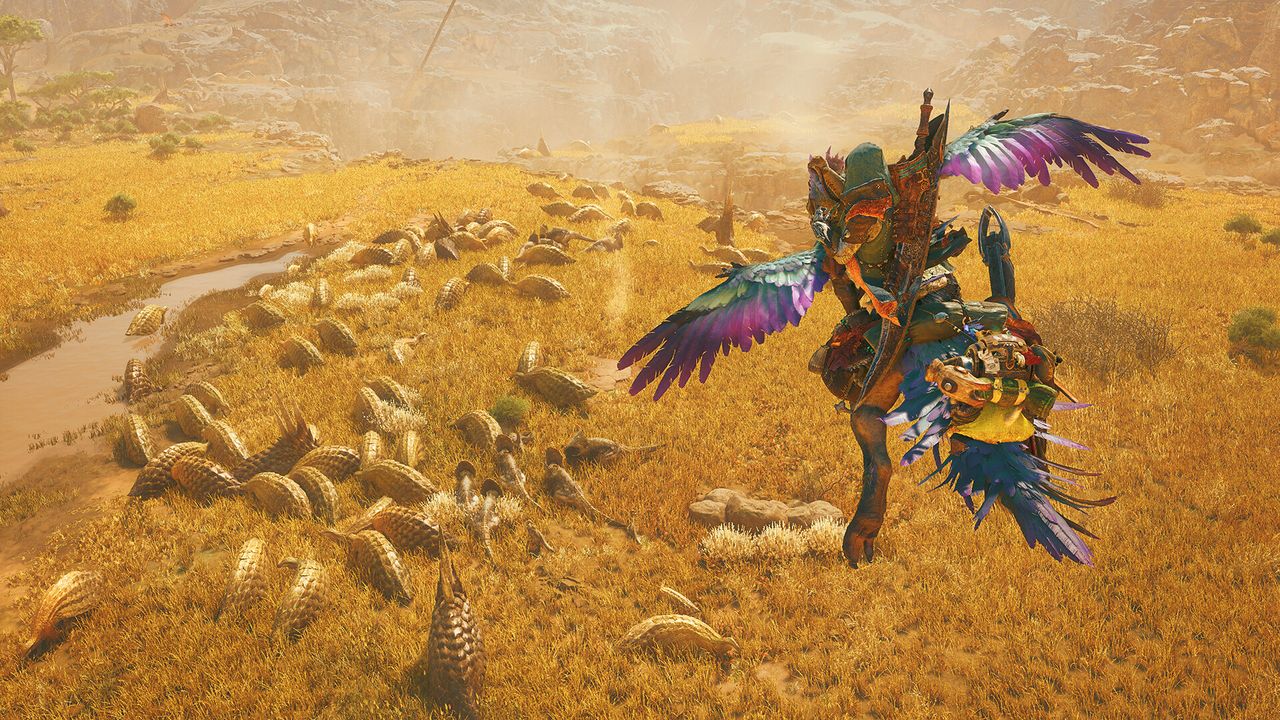
The Seikret is a large bird mount assigned to you at the start of the game. Unlike the combat-focused Palamute from Monster Hunter Rise, the Seikret is primarily a logistics and recovery companion. It does not attack monsters directly, but it changes the flow of a hunt in four ways:
- Auto-path navigation — set a destination or target monster and the Seikret takes you there automatically, collapsing the old tracking phase down to seconds.
- Dual weapon loadouts — the Seikret carries your second equipped weapon set. You call it, mount up, and swap weapons in a single smooth action — a brand-new mechanic to the series.
- Emergency pickup — when a monster knocks you down, you can call the Seikret to scoop you up and carry you away while you heal.
- Item collection while riding — pick up gathering nodes along the Seikret's route without dismounting.
The combined effect is faster, more dynamic hunts — the downtime of tracking, re-sharpening, and healing is largely moved to Seikret-riding time. Against multi-phase monsters whose weaknesses shift, swapping weapons mid-hunt becomes a real-time tactical option rather than a pre-planning exercise.
06Weapon Swapping Strategy on the Seikret
The weapon-swap system rewards forethought. Set your primary and secondary loadouts from the tent or camp chest, treating them as two deliberately chosen tools for the same fight:
- Exploit phase shifts — bring a raw-damage weapon and an elemental weapon tuned to the monster's second weak point, swapping when it enrages or transitions.
- Pair melee with ranged — a Hammer for grounded head-breaking phases and a Bow or Light Bowgun for airborne phases is a highly effective combination.
- Manage sharpness remotely — sharpen the weapon you are not currently using while riding, so both weapons stay ready.
- Call timing matters — do not call the Seikret mid-combo; use a natural break (monster fleeing, or your Palico landing a Provoke) to mount up safely.
- Recovery window — if low on HP and out of potions, call the Seikret, swap weapons to buy time, and heal while riding before re-engaging.
Veterans coming from World or Rise often underestimate the Seikret early and treat it as a fast-travel tool. The weapon-swap and emergency-pickup mechanics become essential by High Rank, where monster damage punishes single-loadout rigidity.
FAQ
Can you change your Palico's support type after the game starts?
Yes. You can adjust your Palico through the Palico menu accessible from your tent or the main hub. Switching support type changes which moves it prioritises, but you keep any moves already unlocked, and gear you have crafted and equipped stays on the Palico regardless of the type change.
How do you unlock more Palico support moves?
Several moves are available from the start and cycle automatically based on your Palico's support type. Additional moves are unlocked by progressing the story and completing specific quests. Check your Palico's move list in the menu to see which moves are still locked and what is required to unlock them.
Can the Seikret help if you get knocked down during a hunt?
Yes — the Seikret's emergency pickup works while you are downed and vulnerable on the ground. You call it and it carries you away so you can heal. It does not prevent a cart if your HP hits zero before you call it, so use it early in a dangerous knockdown rather than waiting.
Does Palico gear matter much or is it just cosmetic?
Palico gear is mechanically significant. The Palico's weapon attack stat affects how much damage it deals and how reliably it applies status effects like paralysis. Its armour's defense determines how often it faints, which directly reduces the frequency of its healing and buff moves. Keeping Palico gear upgraded in step with your own is one of the easiest free performance gains in the game.
Sources
Where the facts on this page were checked. If one of them now says something different, we want to know — tell us and we will fix the guide.
New & updated guides ship every week. Follow the Atom feed or get notified when new Monster Hunter Wilds guides land.